Estimating the predictability of questionable open-access journals
Science Advances, 11(35), eadt2792 · 2025
Abstract
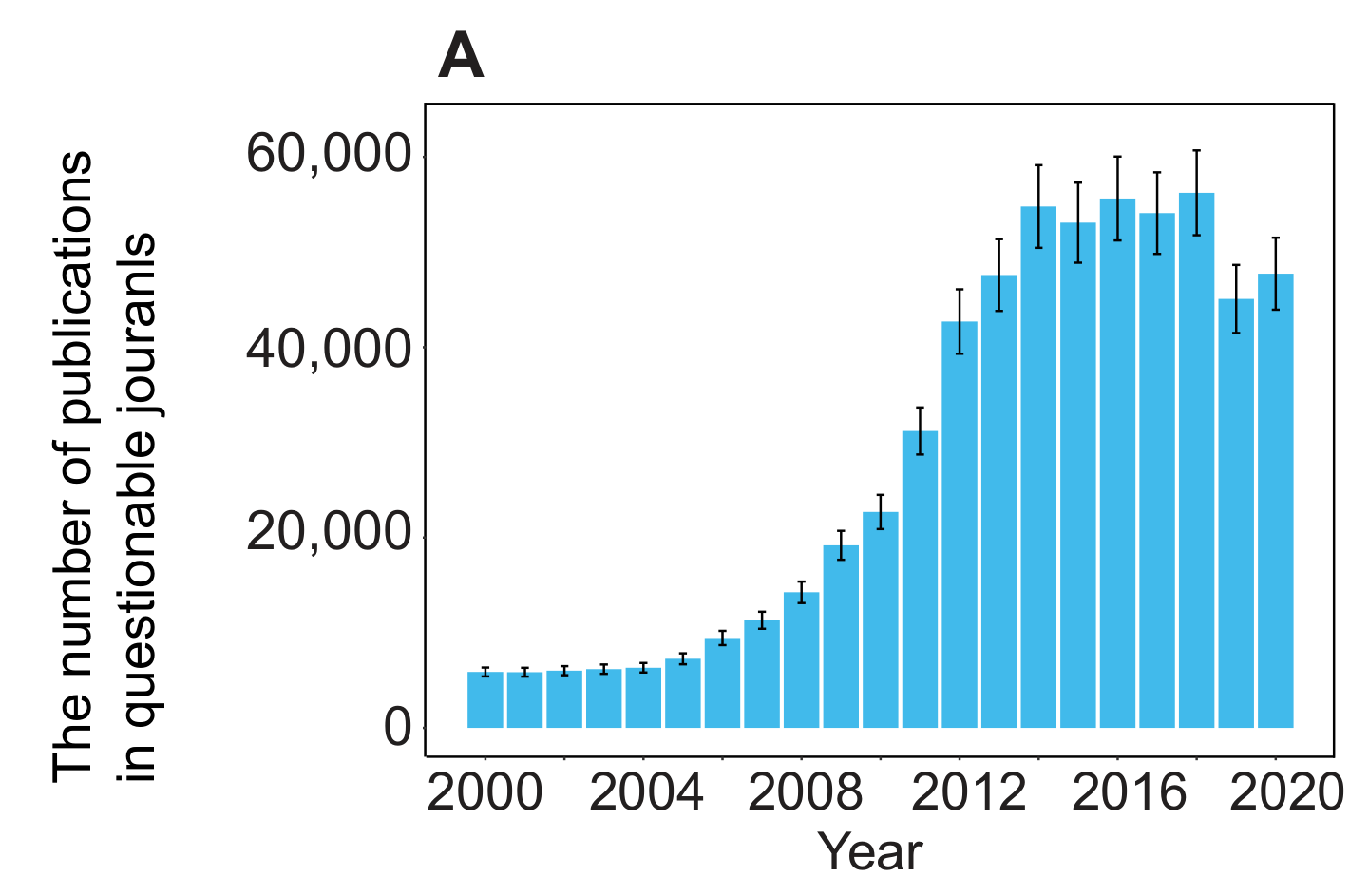
Questionable journals threaten global research integrity, yet manual vetting can be slow and inflexible. Here, we explore the potential of artificial intelligence (AI) to systematically identify such venues by analyzing website design, content, and publication metadata. Evaluated against extensive human-annotated datasets, our method achieves practical accuracy and uncovers previously overlooked indicators of journal legitimacy. By adjusting the decision threshold, our method can prioritize either comprehensive screening or precise, low-noise identification. At a balanced threshold, we flag over 1000 suspect journals, which collectively publish hundreds of thousands of articles, receive millions of citations, acknowledge funding from major agencies, and attract authors from developing countries. Error analysis reveals challenges involving discontinued titles, book series misclassified as journals, and small society outlets with limited online presence, which are issues addressable with improved data quality. Our findings demonstrate AI’s potential for scalable integrity checks, while also highlighting the need to pair automated triage with expert review.
From the original work, under its Creative Commons license.
Research question
Can journal websites and publication metadata help identify journals that warrant closer investigation?
Finding
At a 50% decision threshold, the classifier flagged 1,437 of 15,191 journals. Manual review estimated that 24% of flagged journals were false positives, supporting automated screening as a guide to expert investigation.
A model flag is not a determination of misconduct. Errors included discontinued titles, misclassified book series, and small society journals with limited web presence.
Media coverage
- AI tool labels more than 1000 journals for ‘questionable,’ possibly shady practices
- Hundreds of suspicious journals flagged by AI screening tool
- AI Helps Flag Potentially Problematic Journals for the First Time
- AI helps identify over 1000 dubious open-access journals from screen of 15,000 titles
- Artificial intelligence could help detect ‘predatory’ journals
- AI Helps Spot 1,000 ‘Questionable’ Journals
- AI spies questionable science journals, with some human help
- AI clamps down on fake science journals
- New AI tool identifies 1,000 ‘questionable’ scientific journals
- AI exposes 1,000+ fake science journals
- AI Tool Flags Predatory Journals, Building a Firewall for Science
Cite this work
Han Zhuang; Lizhen Liang; Daniel E. Acuna (2025). Estimating the predictability of questionable open-access journals. Science Advances, 11(35), eadt2792. 10.1126/sciadv.adt2792.
@article{zhuang2025estimating,
  title = {Estimating the predictability of questionable open-access journals},
  author = {Zhuang, Han and Liang, Lizhen and Acuna, Daniel E.},
  year = {2025},
  publication_date = {2025-08-27},
  journal = {Science Advances},
  volume = {11},
  number = {35},
  pages = {eadt2792},
  doi = {10.1126/sciadv.adt2792},
  url = {https://doi.org/10.1126/sciadv.adt2792}
}